Welcome to Compose. There's lots of stuff here, all about composing paintings.

Current entries appear in Dianne's weekly newsletter.


Showing posts with label Direction. Show all posts

Wednesday, November 23, 2011

The Power of Direction

For ages, artists have been using directional movement to compose their paintings.  Directional movement is any visual movement in an art work created by a line or by the alignment of shapes or color or value contrast.


The classic is the triangle on which artists depend for giving both balance and dynamics to their work.   From before Rembrandt to after Norman Rockwell, today's art collections are filled with paintings whose compositional structure is some variation of this directional movement scheme.

"Storm on the Sea of Galilee"   Rembrandt van Rijn
1633
In this Rembrandt painting, the upper diagonal of the triangle is created by line, but the lower two are created by the alignment of shapes.


 "Fishing"     Norman Rockwell      1971


In  this Norman Rockwell painting, the lower side of the triangle is created by line with the other two sides being created by the alignment of shapes.


There is a variation on the scheme that is also found in this Rockwell piece.


Opposing diagonals that counter balance each other
There are opposing diagonals and accompanying verticals and horizontals.

Vertical and horizontal that give stability.


Because a single diagonal movement feels unstable, like when we are falling, some other movement is needed to give it balance. An opposing diagonal can do this, so can a strong horizontal or vertical or a combination of these.  In Rockwell's piece we see all of these at work.

Look at these two paintings by John Burton.

"Changing Tide"       Oil


"Dance of the Lupine"     Oil

Two totally different subjects with the same directional movement.

Look at how the strong diagonals are balanced with both a horizontal and a vertical.


It works in all genre whether landscape, still life or portraiture. And the exciting thing is that the direction of light can be set up to reinforce one of the directions.   Qiang Huang is masterful at doing this.


"Still and Alive"       Oil


Here's the theoretical explanation of how it works:  Both the horizontal and vertical direction give visual stability.  The horizontal serves to calm things down, to give a feeling of being at rest; the vertical gives anchor and a fulcrum for balance.  A diagonal, though, gives energy and motion.  That's why verticals and horizontals are often used to stabilize a piece containing many diagonals or other energetic elements.

It all goes back to nature, to our psychology and the physics of our bodies.  When we are in a horizontal position we are at rest, in a vertical position we are anchored to the surface on which we are standing, but in a diagonal position without any support, we're most likely falling.  

Once again we see how the principles of composition are live forces rather than baggage to be dealt with or ignored.

Friday, January 30, 2009

Direction: The Control Element

In no art form is the visual element direction more evident than in figure skating on ice. A figure skating choreograph resembles a Jackson Pollock painting with eights and circles and straight line pitches, vertical leaps...
Figure skating choreograph by artist Larisa Gendernalik

Paint by Jackson Pollock "Number 8"

Couples Figure Skating--Photo from mahalo.com

I can remember many years ago a certain figure skater whose routine was not much more than a set of circles with a flying bird body formation. I thought it was quite boring at the time, but we don't see any of that these days. No indeed. Figure skating can be heart-stopping with the many multi-directional changes and leaps.

Likewise, I notice that paintings with a strong directional dynamic hold my attention much longer than those whose movement is too quiet and static. Movement is the key word here: we use the visual element direction to create visual movement. Visual movement creates visual paths. And the nature of movement can create rhythm. So a lot rides on how we use direction as a part of our visual language.
We all know what direction is. North, south, east, west, right, left, up, down, around and around--all those points to which we are constantly aiming and switching. You can't even get out of bed in the mornings without changing direction. And we use "changing direction" as a life metaphor, business metaphor, relationship metaphor, behavior metaphor.

It's role in our painting? To control the viewer's attention. That sounds pretty important, right? Okay, so what do we have available to work with. Well, we can use horizontals (right and left), verticals (up and down), diagonals (leaning), and circles ('round and 'round and 'round and 'round). The key is to use these with enough repetition to prevent chaos and enough variation to keep the viewer engaged.

So how do we create with direction? Flow and transition. Two masters come to mind: Charles Reid and Richard Schmid.
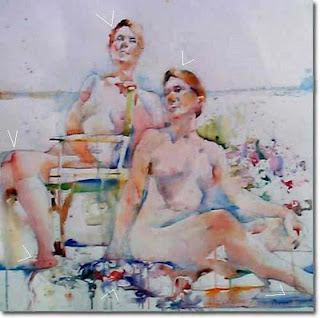
Charles Reid "Two Views: Abby"
1. Accenting points
Charles is adroit at accenting certain points of the total composition so that our eyes want to move --make a transition--from one area to another.

I've indicated some of the major ones with little white arrows. Keep looking--you'll find more

2. Losing edges
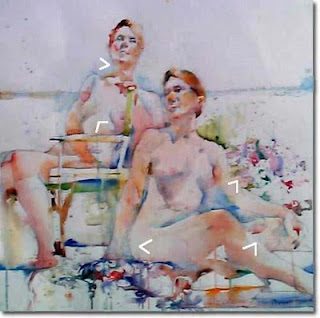
Charles is also adroit at utilizing lost edges, another tool that enables the eye movement to flow and to transition from one area to another.

Again, I've used little white arrows to point out a few key areas. Keep looking, though, and you'll keep finding them.

3. Repeating Color
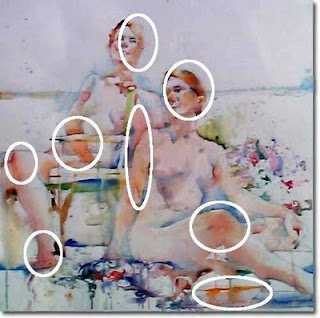
And another of Charles' real genius is his inate ability to repeat color while giving it just enough variation to keep it from being boring. I've circled a few examples here.

These repetitions of color also act both to create flow as well as make transitions.

In a cool background, Charles has used the repetition of warm colors not only to define skin tones and hair, but also to keep the eye moving in various directions.

Next we go to Richard Schmid.
Richard Schmid "Chicken"
4. Guiding Brushstrokes

Richard's delicious brushstrokes are to my mind his trademark genius. Each stroke is guided with intention to define whatever subject is being painted using the careful placement and movement of the stroke.

5. Giving Attention to Edges
Where Charles can lose an edge, Richard can manuver it along the perimenter of the shape to show roughness or smootheness, softness or hardness, swiftness or slowness. His edges are not just perimeters--they control eye movement.

Edges contain characteristics that define the subject. Richard finds these characteristics and renders them in a way that the eye wants to pause and taste it before moving on to the next area.

But perhaps the all time great master of using direction was Leonardo da Vinci. With every thing he did in a painting, he was manipulating our attention just as with every note, volumn and rhythm, Mozart was doing the same thing.
6. Positioning Your Subject
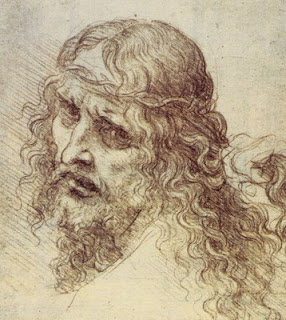
Leonardo turns the face of the Christ-figure toward the left edge, then shifts the eyes to look at the viewer while directing the flow of the hair down the shoulder to the right-hand corner.

He uses a similar ploy in his world-and-ages famous Mona Lisa where the eyes are looking at the viewer, the face is turned slightly toward the left and the hands are positioned toward the right.

Throughout time, where genius has come into play is the artists uncanny ability to notice what's available and to use it adroitly. So we're right back to last week's lesson and all those before. We hone our skills and our eyes and join them together to make it work.