Welcome to Compose. There's lots of stuff here, all about composing paintings.

Current entries appear in Dianne's weekly newsletter.


Showing posts with label Gesture drawing. Show all posts

Saturday, December 17, 2016

Sneaking Some Time to Feed the Inner Artist

Here in the U.S., our long holiday season filled back to back activities and commitments will often rob us of our easel time, time that we all cherish and far too often wish we had more of.  Here's a fun thing you can do in your sketchbook with your feet up watching TV.  It's especially fun during a sports event, but any program where people are doing stuff on the screen will work.
It's the simplest form of gesture drawing taught by Kimon Nicolaides early in the 20th century.  Today, it remains one of the most powerful ways for artists to grab a quick idea.  One example is the sketch Andrew Wyeth did as his initial idea for Christina's World.  
Image
Image
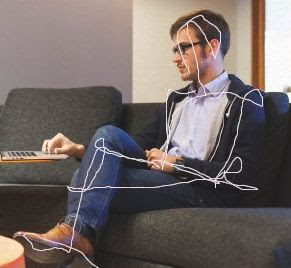
This shorthand method of studying draws only what the figure is doing, not the edges of the shapes.  It's quick, no more than 30 seconds.  Here's one I did of a man sitting.  My attention is on man sitting.  Once the pen starts moving, I follow the feeling of what the head is doing, what the torso is doing, the arms, legs and feet.  Not what it is, but what it is doing.
Image
Below, I've broken down a process I use to give you an idea of how it works. First, what is the head doing?
Image
Next, what the torso is doing?
Image
Finally, what the legs and feet are doing?
Image
Here's a page from my 2011 sketchbook done while I watching the Atlanta Braves play.

Image


Doing pure gesture drawing where you are capturing the movement-- only what the subject is doing-- can feed the inner artist in ways you never could believe.  Give it a try.  

Saturday, February 2, 2013

Breaking Out of Prison

One reason some artists avoid drawing the nude human figure is that, more than any other subject, every mark counts.  Not only is the drawing's success dependent upon the artist's seeing things in the right place, it also demands the artist's confidence in wielding the drawing tool.  A mark intended to define a shadow in the lower back can translate to a wrongly placed hip.  A drag of the finger smudged with charcoal can result in the appearance of a misplaced nose.  A slightly misaligned buttock can cause an onlooker to accuse the artist of imitating Picasso.  So many things can go amiss that too many avoid the intimidation rather than face the challenge.

Avoiding intimidation never solved a single problem.  Rather it imprisons us, causing us to place ourselves in a box where we feel safe and surround ourselves with excuses for being there. The only way to find freedom--to break down the walls of that box--is to enter into the place where the intimidating starts and act.

Being unsure of the drawing materials is quickly corrected by daily practice with the materials, becoming conscious that pencils, charcoal, conté or pen are tools, not mark makers.  Doing studies from master artists' work by attempting to make your tool replicate the marks made by the master artist rather than trying to replicate the image will do wonders towards building your tool's vocabulary.  The Michelangelo drawings I've included below are excellent ones from which to build this skill.
(Michelangelo drawings from The British Museum)

A combination of quick (gesture) and slow (contour) drawings--where your intent it following what your eye is seeing--is an excellent way to gain confidence drawing the figure itself.   To begin with make your focus to capture only the movement--what the figure is doing, rather than the shape.  That's the gesture.  When doing the slower contour drawing, make your intent ONLY to follow your eye along the edge of each shape, inside and outside.   Aim for only one thing at a time and above all, avoid trying to make your drawing look like the subject:  keep your intent on the process.  If it's gesture you're studying, then focus only on the movement; if it's contour, focus only on the edges of the shape.  Just that and nothing else. It's all about controlling where your attention is.

Michelangelo gesture studies
Michelangelo contour studies
For exercises aimed to build your confidence, using photo references is a good way to go and, in spite of what the purists say, if it's helpful towards building your skills, then do it.  If you don't have good photos, the website Pose Space has excellent photos created especially for artists to study from.

If the intimidation comes from either the drawing tool or the subject, I have just shown you a way to enter that place of intimidation and break through it.  Once it's broken, you will have gained a freedom within which your drawing tool can go wherever you want it to go.

________________________________________________

Friday, May 11, 2012

In Praise of Gesture

Gesture drawing is our most direct tool for absorbing the essence of what we see.  Simply defined a gesture drawing captures the movement the artist feels within the subject.  It is the artist's rapid response to what the subject is doing, not how it appears.

Artists have been doing gesture drawing for centuries, but not until the early 20th century did it get its label, thanks to Kimon Nicolaides who left for us a comprehensive study program in his book, The Natural Way to Draw.  (First published in 1941 and available free in a PDF file HERE.)


We are accustomed to contour drawing where the shapes' edges are meticulously followed, our more deliberate or cognitive approach.  Gesture drawing does just the opposite, following the movement of the subject--a more intuitive approach.  Nicolaides taught that both are necessary, each balancing the other.

Here's how he introduces the comparison:


Below, from Nicolaides' book, student drawings illustrate the power of gesture drawing to express what the subject is doing.


Three of our historical masters--Rembrandt, Leonardo and Michelangelo-- each left us volumes of drawings with copious gesture studies among them.  Most often these would be quick studies, responding to something that caught their eye or towards an upcoming painting, but sometimes they would flesh out the gesture drawing with values, as Rembrandt does with his lion sketch.

Rembrandt van Rijn  "Lion Resting"    c. 1650
At other times, we get to see the pure gesture itself, exampled in these Rembrandt studies of a baby nursing and "St Jerome Reading to a Lion".

Rembrandt van Rijn   Study:  Baby Nursing      c.1635
 
Rembrandt van Rijn   Study for St. Jerome Reading    c. 1652

And among the hundreds of Leonardo da Vinci's scientific and analytical drawings are many gesture drawings.

Leonardo da Vinci   Study for the Trivulzio Monument, c. 1508
 Leonardo da Vincin     Study for the Sforza Monument, c. 1488-9 

Even among the many beautifully formed drawings of Michelangelo are his gesture studies.

Michelangelo Buonarroti   Sketches for two separate projects    c.1503

My favorite drawing of all times is Michelangelo's study of Madonna and Child where we see all the gestural lines and restatements along with his beginning to flesh out the form within the gesture drawing itself.
Michelangelo Buonarroti  Madonna and Child Study  c. 1525
One of the most intriguing and exciting uses of gesture I've seen lately is that of artist Omar Rayyan.  His paintings begin with a gesture drawing.  (You may click on any of these to get a larger view.)


Within this drawing, Rayyan searches for the image and begins to develop it in paint.


He continues by refining the drawing and adding more paint as the piece develops.


This process continue until the piece finds its conclusion.

 Omar Rayyan   "The Duel"   Watercolor, 11x17      2011 

Gesture drawing is the closest thing to meditation an artist can experience:  it is drawing without thought, responding with the senses without making judgments.  It is the purest form of observation, taking the artist directly to the essence of the subject. It requires letting go and taking in the world as it is without any intention other than experiencing the subject.  It is fun, relaxing and gives the artist a refreshed sense of renewal.

___________________________________
Saturday, April 16, 2011

The Power of Gesture

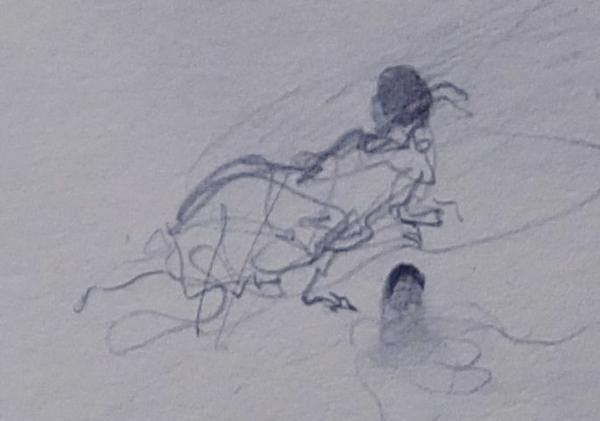
Our gestures express our identity.  Whether in our handwriting,  our gait, or the movement of an arm while talking, folks who know us recognize us as quickly by our gesture as by our voice.

Gesture is movement   Gesture drawing is quick drawing capturing the movement within the subject.  The subject itself might not be moving, but our eyes are in perpetual motion as they scan its visual makeup. Long, subtle curves cause our eyes to move more slowly, short abrupt curves, faster.  We zip right along straight lines and leap from segment to segment when a line changes direction.

When we record these visual movements with a quick, linear drawing--as if doodling--we express the shape's gesture.  Our spectators recognize  the subject by what it's parts are doing rather  than by how it is described.   It is so simple, yet many artists find it challenging.

But for Larry Roebal, it's mere "doodling."
Larry Roebal's "doodle" for April 15, 2011
Almost daily for over the past three years, Larry "doodles" an image from the day's news. Using ballpoint pen, drawing on top of the news article that grabs his attention, he quickly renders a drawing of the news article's subject, then posts the drawing to his daily blog.  Larry calls these gesture drawings "doodles."

Three hundred years ago, there was another "doodler" doing very much the same kind of thing.  You might have heard his name:  Rembrandt.
From the sketchbooks of Rembrandt van Rijn  1606-1669
And five hundred years ago, there was an artist named Michelangelo who was himself quite the doodler .

 From the sketchbooks of Michangelo Buonarroti (1475-1564)
This thing we do that Larry calls doodling is an artist's most immediate tool for exploring and discovering  the subject's inherent essence.  It's a means for sharpening our observation skills while doing visual research.  And even though it's not results-oriented, the outcome has a life of its own.

Call it doodling, call it gesture drawing--its label is insignificant.  What is significant is its power to capture and express visually the heart and soul of the subject in the handwriting of the artist.