Welcome to Compose. There's lots of stuff here, all about composing paintings.

Current entries appear in Dianne's weekly newsletter.


Showing posts with label One Point Perspective. Show all posts

Friday, January 20, 2012

Ditching Perspective Rules


How much do you think about the rules of linear perspective when you draw or paint?
One-point, two-point, three-point—just establishing a horizon line and finding vanishing points can be such a chore that many artists find it too stifling to deal with. But there’s a way to find the correct angles of perspective for any object without having to memorize a single rule, and it’s something that artists have been using for centuries: the angle finder.
A brush handle, pencil, finger or even a stick can be turned into an angle finder. All it takes is holding your angle finder at arm’s length, closing one eye, and aligning it with the edge of the object you’re planning on drawing.
Locating the angle of the an oak tree trunk by using an brush handle as an angle finder.
Finding the angle is simple enough, but sometimes there’s a disconnect that occurs somewhere between reading the angle and translating it to a drawing or painting.  Years ago I recognized this problem among a number of my college students.  I discovered that when students were unsure about the tilt of an angle they were looking at, they could see it better if they could label it.  (An odd thing, labeling: something we humans seem to need.)  To enable an accurate labeling system, I came up with a method to teach angle finding by equating each angle to a number on a clock face.  
It works like this:  stand in front of a clock face holding your angle finder at arm’s length. Position it so that it becomes like another hand on the clock as if connected to the center. Looking with one eye closed,  align the angle finder toward a number on the clock by rotating it either clockwise or counter clockwise to find 7 o’clock, then 9,  12 and 2.  You have just read four perspective angles.


Now try this:  Lay a book on a table, pick up a pencil to use as an angle finder,  stand back three or four feet, hold the pencil on the eraser end, straighten your arm so your elbow won't bend, close one eye, then rotate your pencil until it aligns with the edge of the book's cover.  Look at where the pencil is pointing, then name the angle according to its clock number.  Try this again along the front edge of the book cover.
Keep your attention on the pencil so that it doesn't flop forward or  point backwards.  It  must move only clockwise  or counter clockwise, else it will mislead you.

The photo on the left shows the pencil pointing to a 10 o'clock angle while the one on the right points between 2 and 3.   Labeling these angles according to where we find them on a clock can enable us to draw these angles, by-passing perspective rules .


Try doing a simple line drawing of the book, labeling the angle of each line like I've done in the drawing below.

Practicing the exercise several times can give you a idea of how the system works.  After feeling secure, try the same exercise using a building as your image.

Just like any skill, the more you practice this the more adroit you’ll become at using it. Eventually you will have the clock positions firmly engraved in your memory and you’ll no longer need the clock diagram to help you out.
You will also discover that you’re recognizing angles in many more places, and that it’s much easier to draw them accurately—without ever being concerned about the actual rules of perspective again.
(Disclosure:  this tutorial is an adaptation of a tutorial I wrote for Empty Easel in October, 2008.)
*********************
See Dianne's latest work on One Artist's Journey

**********************


Thursday, November 10, 2011

A Visual Challenge

What do these paintings have in common?

Karen Jurick

Clyde Aspevig

Richard Schmid

Jennifer McChristian

Colin Page

Edward Hopper

Every single composition principle and composing scheme in existence is derived from either patterns in nature, from laws of physics or from how our eyes work.

The beauty of past artists' having discovered and verbalized these principles is that today we can study them and learn how to use them in a brief time, especially compared to the centuries it has taken to understand and explain them.  More exciting than that is how each of them can be utilized in so many ways, many of those still being discovered today.

So have you found what the paintings above have in common?

The answer is converging lines.


This composing scheme is in essence one-point perspective.  Italian Renaissance architect Filippo Brunelleschi is credited with discovering that when we're looking at parallel lines, our eyes make those lines converge to a single vanishing point.  What's amazing is that this scientific fact is also an artistic principle.


By exercising this principle onto a two-dimensional surface, we create the illusion of seeing into three-dimensional space.

Whether painting people or an interior or the outdoors, artists use this principle to add the dynamics of distance and movement in space.

Karen Jurick uses it in this painting to show the depth of a room and to show the distance between the couple on the right and the individual on the left.  And the lines' converging outside the paintings gives us the sense that there is a continuation of something beyond the painting itself.


Clyde Aspevig shows a similar continuation beyond the painting with the same method.


Colin Page, Jennifer McChristian and Richard Schmid each use the covergence to keep the viewer inside the painting, each showing a different variation on where the lines come together, therefore each placing the viewer in a slightly different vantage point.  Whether the vanishing point is place inside or outside the painting,  we have the illusion of being in a three-dimensional space.  


Like Aspevig and Jurick, Edward Hopper's lines converge outside the painting,  He made a choice to place the viewer slightly to the left of the sitting man rather than peer directly at him head-on, giving a feeling of his sitting on a walkway that goes outside the painting.


Using converging lines gives both order and dynamics to a painting:  order in that shapes are aligned rather than being randomly placed and dynamics in that converging lines keep the eye moving.  Keeping this in mind, the artist need not be bothered with having to memorize rules of perspective.
_________________________________

Note:  My pre-Christmas auction of little paintings has now begun with two paintings.

  You can bid on "After the Rain" HERE


and/or on "Downtown Tate City" HERE.


Friday, September 23, 2011

Getting To the Point

An adroit artist can focus our attention without our being aware of what's happening. One easy method to make this happen is a visual device called  one-point perspective, an approach artists have been using for centuries.

Photographer unknown
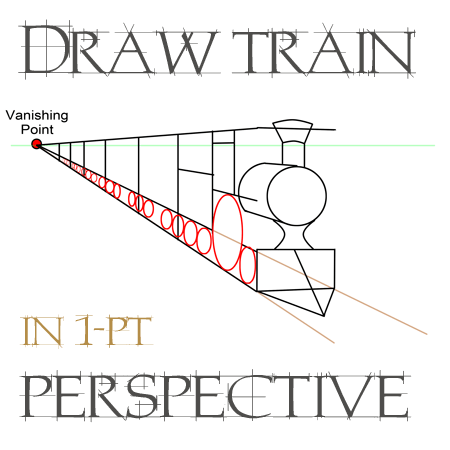
Notice in this photo how all lines converge to  a single point.  That's how one-point perspective works.

Take a look at how artist Joe Paquet uses this device.

"Classic Saint Paul"      8" x 12"     Oil on Canvas

Pretty elementary, right.  One-point perspective works when the artist arranges major shapes or points of emphasis so that our eyes are guided toward a single area called a vanishing point.   It's a natural consequence of how the eye sees parallel lines in real life.  It comes with our natural ability to see depth as when we're looking down a hallway.

Photo by MarvinOS

Just like they do with all of nature's organizing systems, artists find intriguing ways to employ one-point perspective.  Look at how Paquet found it and made it work here.

"Santa Rosa Creek Road"     12' x 16"   Oil on Canvas


 He's a  bit more subtle in this next piece.

Eagles' Nest Stage Stop    8" x 10"   Oil on Canvas

And he does a similar thing here.


"Queen Anne's Lace"       8" x 10"    Oil on Canvas


One-point perspective is not so much a composition principle as a structural device that can guarantee an artist both an eye path and correct visual perspective.  Sometimes a scene will contain exactly what you need; at other times the artist will make a few adjustments to enable the images to fall within the structural intention.

Probably one of the most ingenious one-point perspective painting ever was done more than 600 years ago:   Leonardo da Vinci's "Last Supper."


Have a fun weekend.
Dianne