Welcome to Compose. There's lots of stuff here, all about composing paintings.

Current entries appear in Dianne's weekly newsletter.


Showing posts with label abstract. Show all posts

Saturday, February 18, 2017

How Edges Influence Our Paintings

Look at this abstract composition.  Notice that all the shapes' edges are sharp.  How our eyes move over the piece is determined more by location of shapes and their value contrast with their surroundings.
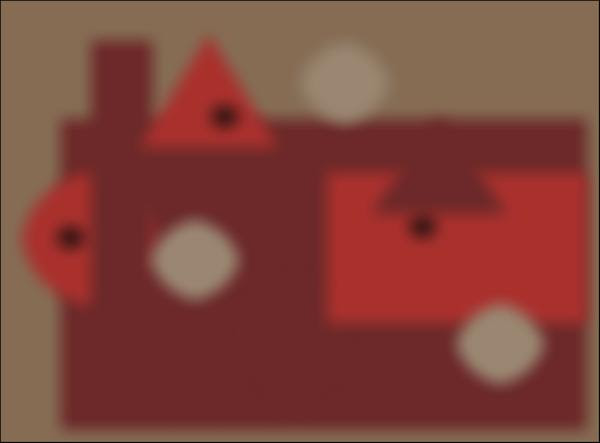
Let's change that up a bit and throw all the edges out of focus.  Notice how you react to that--we want something to be in focus:  Anything!
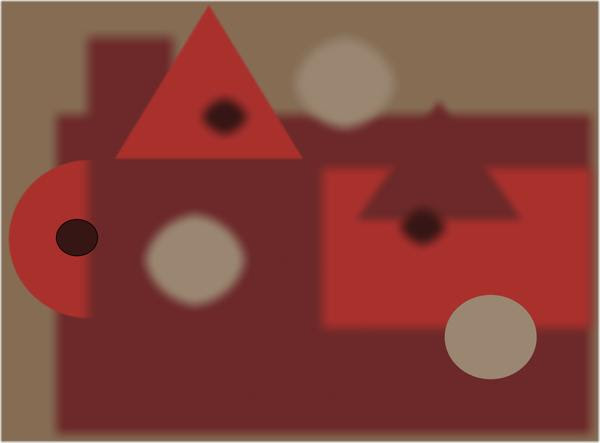
Now in this next design, pay attention to where your eyes go first.  Do they migrate to that dark triangle on the right?  The only shape that's in focus?  I bet they do. 
 
How do your eyes perceive this one with all but three shapes in focus?  Scan backwards now and notice the difference in your response to each design.  The shapes, colors, values and placement are the same.  Only the handling of the edges is different. 
Here's one more.  How would you handle the edges in this one to make the design more pleasing to you?    
 
Whether our designs are realistic images or abstract, how we handle the edges of all our shapes will influence the perception of the total piece.  All these examples play only with soft and sharp edges.  Other choices are broken, jazzed, lost, gradated--possibilities are limited only to the imagination.  What's important is that we notice what we are doing and find ways to use edges to strengthen our compositions. 

Saturday, December 3, 2016

A Fun Way To Abstract

Behind every good painting is a sound abstract design.  In visual art most of the 20th century was devoted to some sort of abstraction.  Today many artists paint abstractly, but to a lot of people abstraction is meaningless. That's too bad because understanding abstraction can go a long way towards enhancing a realistic work whether photo-realistic or more impressionistic.
Here is an experiment that can open up for you one way abstraction can work.  In science, experiments often begin with setting intentions, so that's what we will do first.  The subject is the photo of tomatoes below.
OUR INTENTIONS
1. We will use only one tool, a flat brush, and with it we will use only a straight, flat stroke
2.  We will focus only on color
3.  Each stroke will take on a different direction than the previous stroke of the same color
4.  Each color is repeated at least twice.
Image
First pass:  Doing those four intentions, we'll place the lighter value reds of the tomatoes.
Image
Second Pass:  Still using the four intentions, we'll use the darker reds.
Image
Third Pass:  We add the lighter greens.
Image
Fourth pass:  We add the darker greens.
Image
Fifth pass:  The lighter grays.
Image
Sixth pass: The darker neutral reds
Image
Seventh pass:  The darker grays
Image
Eighth pass:  The middle value greens
Image
Ninth pass:  More light grays and the abstract is complete
Image
The sequence of color selection doesn't matter.  What matters is following the four intentions.  
 
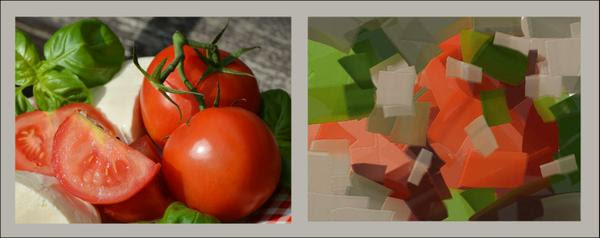
Here is the subject and the abstract that grew out of it..  Why not try choosing a photo and abstracting it using this process.
Image